
If you've started shopping for life insurance, you've probably run into two very different answers to "what should I get": term life and indexed universal life (IUL). Both are legitimate tools. They just solve different problems — and a lot of the confusion comes from the two being pitched as if they compete head-to-head, when really the right question is what you're trying to protect.
The core difference
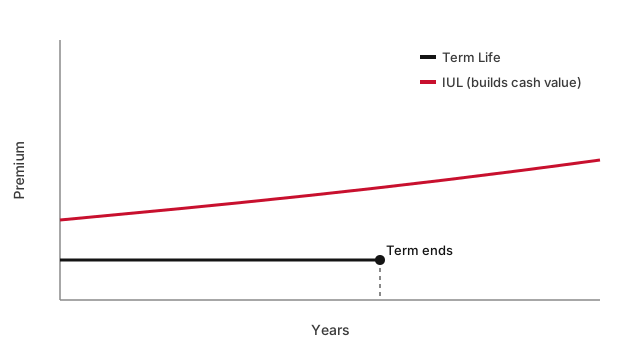
Term life is temporary, pure protection. You pick a length — 10, 20, 30 years — and a death benefit. If something happens to you during that term, your beneficiaries get the payout. If you outlive the term, the policy simply ends. There's no cash value, no investment component — just coverage, at the lowest cost per dollar of protection you'll generally find.
IUL is permanent coverage with a savings component attached. Part of your premium goes toward the death benefit; part builds cash value that can grow based on the performance of a market index (like the S&P 500), typically with a floor that protects against losses in a down year and a cap that limits how much of a strong year's gains you participate in. It costs more than term for the same death benefit, because you're funding two things at once.
Side by side
| Term Life | IUL | |
|---|---|---|
| Purpose | Replace income for a set period | Lifelong coverage + tax-advantaged growth |
| Cost | Lower premium | Higher premium |
| Duration | Fixed term (10–30 years) | Permanent, as long as funded |
| Cash value | None | Yes, tied to an index with a floor/cap |
| Flexibility | Low — fixed benefit and term | Higher — many policies allow adjusting premiums/benefit |
| Typical fit | Mortgage, income replacement while kids are young | Retirement income diversification, estate planning, lifelong needs |
Questions that actually decide it — not the product name
- Is the need temporary or permanent? A 20-year term matched to your mortgage or your youngest child's path to independence is usually the more efficient tool for a temporary need.
- Are you already maxing out other tax-advantaged accounts? IUL's appeal is largely about tax diversification in retirement — it matters more once you've already used up 401(k)/IRA contribution room, less if you haven't.
- Do you want to actively manage a policy? IUL requires more ongoing attention — cap rates, crediting strategies, and funding levels can all change how it performs. Term is close to "set it and forget it."
- What's your budget actually built for? An underfunded IUL can lapse or underperform expectations. If the budget is tight, a properly-sized term policy usually beats a stretched IUL policy.
None of this is a reason to avoid IUL — it's a legitimate strategy for the right situation. It's also not a reason to default to term just because it's cheaper. The point of comparing carriers independently is finding out which one actually matches your timeline and budget, rather than starting from a product and working backward to justify it.
The no-pressure version
There's no universally "better" answer between these two — anyone who tells you there is is selling something. The honest starting point is your actual timeline and budget, not the product name.
Not sure which coverage fits?
Most people aren't. That's what the free walkthrough is for — bring your questions, we'll bring the comparisons.
Book a Free Walkthrough